

Wheel alignment is one of those services most drivers have heard of, but few can explain. It isn’t about the wheels themselves. It’s about the angles at which they meet the road, and those angles decide how your car steers, how long your tires last, and how steady it feels at highway speed.
In simple terms, wheel alignment is the adjustment of your suspension so that all four wheels point in the direction the manufacturer intended, sit at the correct tilt, and work together. When those angles drift, the car still drives, but it works against itself. This guide explains what an alignment adjusts, why it matters, the signs it’s off, and when to have it checked.
The three angles an alignment adjusts
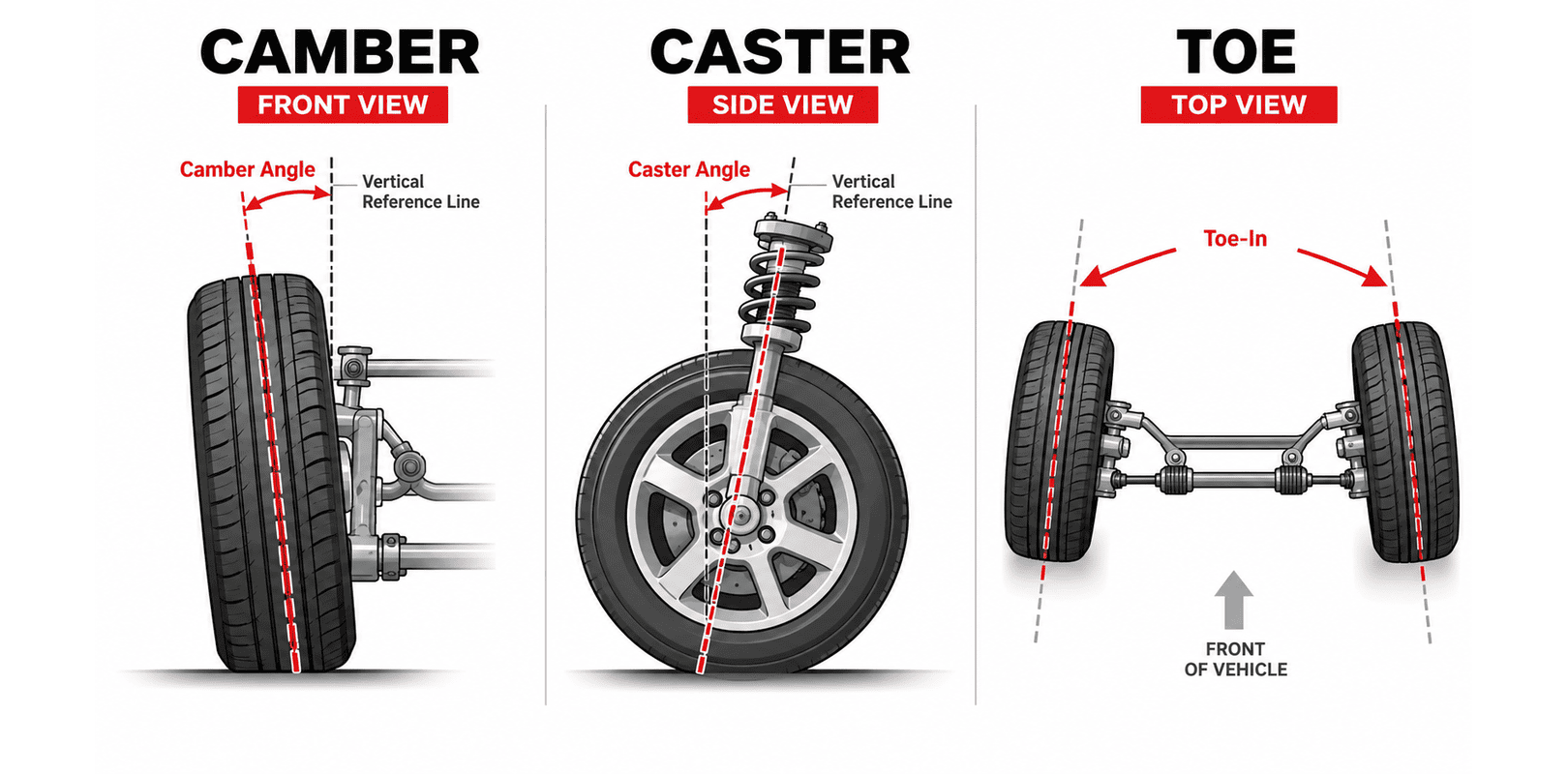
Every alignment measure and corrects three main angles against your vehicle’s factory specifications.
- Camber is the inward or outward tilt of the top of the tire when you look at the car from the front. Too much tilt either way wears one edge of the tread faster than the other.
- Caster is the forward or backward tilt of the steering pivot when you look at the car from the side. It helps the car track straight and brings the steering wheel back to center after a turn.
- The toe is whether the front edges of the tires point slightly toward each other (toe-in) or away from each other (toe-out) when viewed from above. Toes have the biggest effect on tire wear. Even a small error makes the tires scrub sideways as they roll.
On a four-wheel alignment, the rear wheels are measured and set as well, so the rear axle points in the same direction as the front, and the car doesn’t “crab” down the road.
Why wheel alignment matters: the main benefits
A correct alignment pays off in ways you notice every day and in ways you only see over time.
Longer tire life
Misaligned wheels drag their tread across the road. Correct angles let tires wear evenly, so a set lasts closer to its rated mileage.
Straighter, safer handling
The car tracks in a straight line without constant corrections and responds predictably in an emergency lane change or on a wet road.
Better fuel economy
Tires that scrub sideways create extra rolling resistance, and the engine works harder to overcome it.
Less wear on other parts
Steering and suspension components last longer when they aren’t fighting a wheel that wants to go a different direction.
A more comfortable drive
A centered steering wheel and a car that doesn’t pull make long drives less tiring.
Signs your wheel alignment is off
Misalignment usually builds slowly, so it’s easy to get used to. Watch for these signs:
- The car drifts or pulls to one side on a straight, level road.
- The steering wheel sits off-center when you’re driving straight.
- The inner or outer edges of your tires wear faster than the middle.
- Tires squeal during normal turns at low speed.
- Steering feels loose, wandering or slow to respond.
- The steering wheel vibrates at certain speeds.
Some of these, especially vibration, can also come from unbalanced wheels or worn parts. That’s why an alignment check usually starts with a look at the tires and suspension.
When to get your alignment checked
There’s no single interval that suits every vehicle, but these are the common times to have it checked:
- Once a year, or as your owner’s manual recommends, even if nothing feels wrong.
- When you install new tires, the new set starts wearing evenly from day one.
- After a hard impact, such as a deep pothole, a curb strike or an accident.
- After suspension or steering work, including control arm, strut, tie rod or ball joint replacement.
- When you notice any of the signs above.
- After lifting or lowering the vehicle, ride height changes the angles.
Kansas City’s freeze-thaw cycles fill the roads with potholes every winter and spring. If you’ve hit one hard enough to feel it through the steering wheel, a check is worth it.
What happens during an alignment check
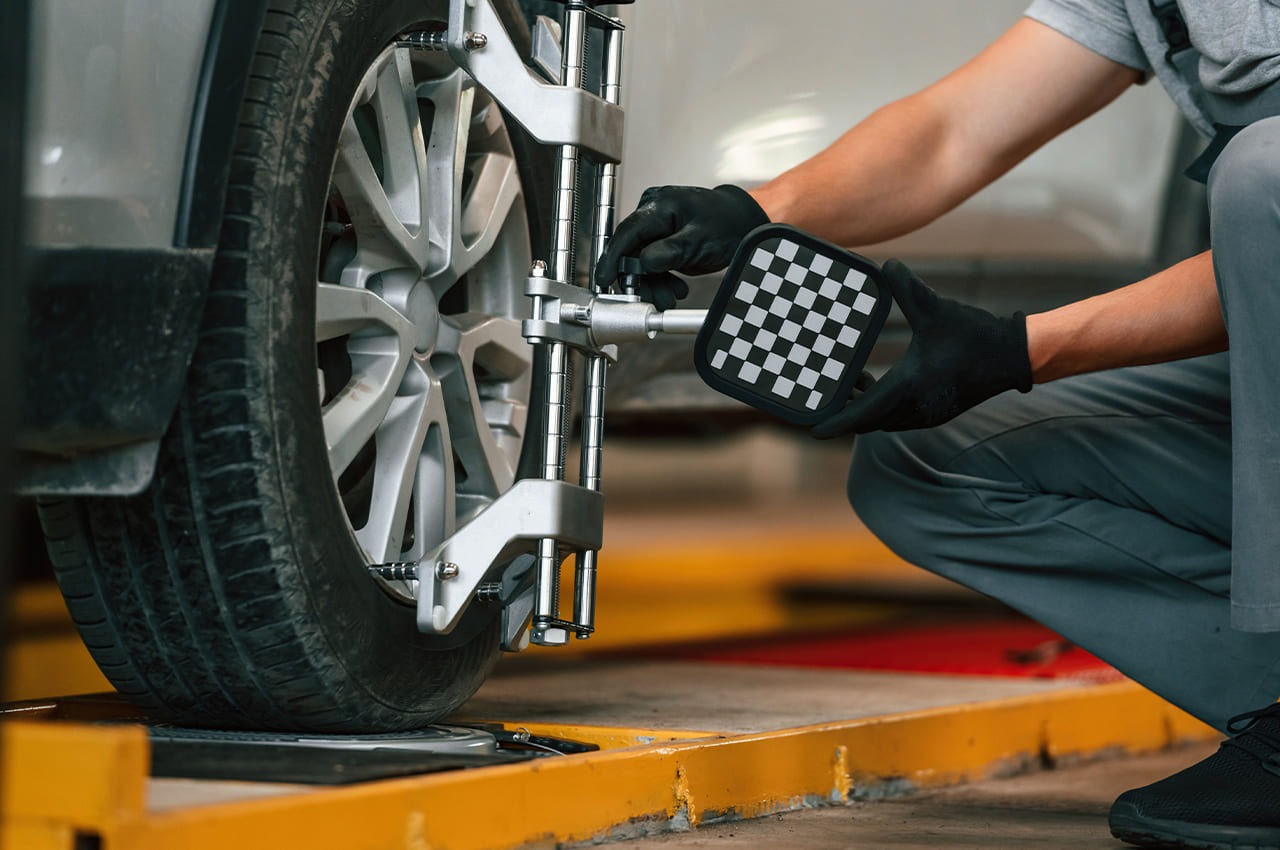
A modern alignment uses a computerized machine with sensors or targets clamped to each wheel. A typical check includes:
- Inspecting the tires, rims, and tire pressure.
- Check the steering and suspension parts for wear or play.
- Measuring camber, caster and toe at each wheel.
- Adjusting the angles back to the manufacturer’s specifications.
- Re-measuring to confirm, and road testing the vehicle.
On most vehicles, the job takes about an hour. You can see what the process covers on our wheel alignment service page.
Why an alignment sometimes doesn’t hold
An alignment can only be as good as the parts holding the wheel in place. If the car starts pulling again within weeks, worn suspension parts are a common reason. Lose tie rods, a worn ball joint or worn control arm bushings let the wheel angles shift as you brake, accelerate or hit bumps, even if they measured correctly on the machine. That’s why a good alignment check includes a look at these parts first.
Wheel alignment vs balancing vs rotation
These three services are often mixed up, but each solves a different problem.
Service | What it does | Fixes |
Wheel alignment | Adjusts the angles of the wheels relative to the car and the road | Pulling, an off-center steering wheel, edge wear on tires |
Wheel balancing | Adds small weights so each tire and wheel spins evenly | Vibration at certain speeds |
Tire rotation | Moves tires to different positions on the car | Uneven wear between front and rear tires |
They work best together. Rotation spreads wear, balancing keeps the ride smooth, and alignment makes sure the tires roll straight in the first place.
Small angles, big difference
Wheel alignment comes down to fractions of a degree, but those fractions decide how your tires wear, how your car tracks and how confidently it handles. Checking it once a year, and after any hard hit or suspension repair, is one of the simplest ways to protect your tires and keep the car driving straight.
If your car has started pulling or your steering wheel is sitting off-center and you’d like to know why, you can reach out to our team.