
A used car can look spotless in a driveway and still be hiding a leaking head gasket, a rusted brake line or a transmission that’s on its way out. A test drive around the block won’t show you most of that.
A pre-purchase inspection is how you find out before the money changes hands. Here’s what a good one covers, what you should get at the end, and what it can’t promise.
Before the car arrives
The work starts with the VIN. A vehicle history report will show reported accidents, title problems and odometer readings over time. It’s also worth checking the VIN for open recalls, which dealers and private sellers don’t always mention.
Ask the seller for any maintenance records, and ask them not to drive the car right before the appointment. A cold start tells us more than an engine that’s already warm. Most honest sellers are fine with an independent inspection. A seller who won’t let you do that is telling you something.
Body, frame and rust
On the lift, we look for signs of past crash repair: uneven gaps between panels, paint that doesn’t quite match, overspray on rubber trim and welds or kinks where the frame shouldn’t have them. A car that was repaired well isn’t automatically a bad buy, but you should know about it and pay accordingly.
Rust gets extra attention around here. Kansas City roads are salted and brined every winter, and that salt works its way into subframes, rocker panels, brake lines and fuel lines. Surface rust is normal on an older car. Rot that flakes away or eats through a line is not.
We also check for flood damage, which can turn up anywhere cars change hands. Warning signs include:
- A musty smell or new carpet in an older car
- Silt or a water line under the seats or in the trunk
- Rust on seat rails, screws or other parts that normally stay dry
- Fogging inside headlights or electrical problems that come and go
Under the hood
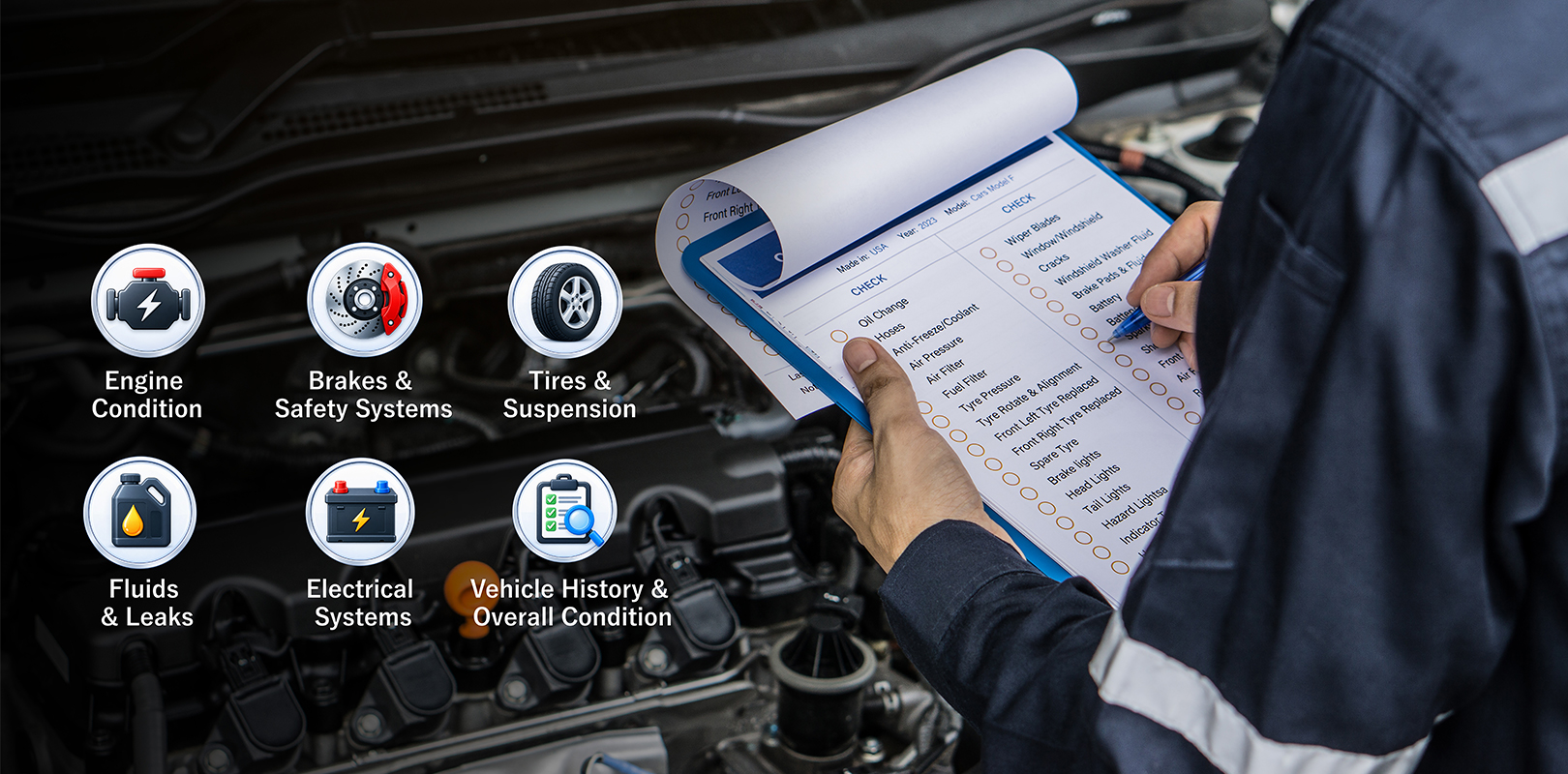
Fluids tell a story. We check the level and condition of the oil, coolant, brake fluid, transmission fluid and power steering fluid. Milky oil, coolant that smells burnt or looks rusty, and dark, gritty transmission fluid are all reasons to slow down. We also look for fresh leaks, and for an engine bay that’s been scrubbed suspiciously clean.
Belts and hoses get a close look for cracks and soft spots. We run a battery test and check the charging system, and we pressure-check the cooling system when there’s any sign of trouble. If the engine uses a timing belt, find out when it was last replaced. On many engines, a belt that snaps can cause serious internal damage, and the replacement isn’t cheap.
The computer scan
A diagnostic scan reads stored and pending trouble codes, even when no warning light is on. Just as important, it shows the readiness monitors. If they show “not ready,” the codes may have been cleared recently, sometimes to hide a check engine light just long enough to sell the car.
Brakes, tires, suspension and steering
A full brake inspection covers pad thickness, rotor condition, calipers, hoses and fluid. Tires get checked for tread depth, age and wear pattern. Wear on one edge usually points to an alignment problem, and sometimes to bent or worn suspension parts behind it.
We check ball joints, tie rod ends, control arm bushings and shocks and struts for play and leaks, and look at the steering rack for seepage. Worn front-end parts are common on higher-mileage cars and can add up quickly.
Transmission, AC and everything inside
We look at CV boots, axle seals and the differential, and note how the transmission shifts on the road test. We check that the AC system blows cold and the heater blows hot, because a Kansas City summer and a Kansas City January will both find out quickly if either one doesn’t work.
Inside, we go through windows, locks, lights, wipers, the horn and the dashboard warning lights. Every warning light should come on briefly at startup and then go out. One that never lights up at all may have been disabled.
The road test
The drive covers city streets and highway speed. We listen for knocks, whines and clunks, feel for vibration, and check that the car brakes straight, tracks straight and shifts smoothly both warm and cold.
What you get at the end of a pre-purchase inspection
You should leave with clear findings, sorted by how much they matter:
Priority | What it means |
Fix before buying | Safety problems or major failures, such as brake, steering or structural issues |
Needs attention soon | Items that will need money in the next few months, like tires or worn suspension parts |
Can wait | Minor wear and routine maintenance items |
Because we’re a full repair shop, we can price the repairs too. That estimate gives you something concrete to take back to the seller, and it’s often worth more in negotiation than the inspection costs.
What an inspection can’t tell you
An inspection shows the condition of the car on the day we see it. It can’t predict every future failure, and we don’t take the engine apart to look inside. Think of it as a detailed snapshot, not a warranty.
Buying in Kansas? One more inspection to know about
If the car was last titled in another state, Missouri included, Kansas requires a VIN inspection through the Kansas Highway Patrol before you can title it here. That confirms the vehicle’s identity. It doesn’t check its mechanical condition, so it’s no substitute for a pre-purchase inspection.
SK Automotive is on Merriam Lane in Kansas City, KS, close to Merriam, Mission, Overland Park and the Missouri side of the metro. If you’ve found a car, book a pre-purchase inspection before you pay. Call ahead and we’ll give you a time and a price before the seller brings it in.